Most people stumble onto Thiruvilwamala by accident. They were driving somewhere else, someone mentioned the temple, they took a detour, and suddenly they’re standing on a hill 100 feet above sea level watching the Bharathapuzha curve through paddy fields below, wondering how a place this unhurried exists in 2025.
It’s a small temple town in Thrissur district, 47 kilometres northeast of the city, on the banks of the Nila. There are ancient shrines here, a cave that opens once a year on a specific festival day and draws thousands of pilgrims for a ritual that has been happening for centuries, handloom weavers in the neighbouring village of Kuthampully still producing Kerala’s GI-tagged kasavu sarees on traditional looms, and a river wide enough and slow enough that sitting beside it for an hour feels like a form of treatment.
The problem is that most travelers who find their way here have nowhere good to stay. Thiruvilwamala doesn’t have the kind of hotel infrastructure that the larger Kerala tourist towns do, which is both its greatest limitation and, oddly, its greatest charm. The places worth staying are almost always private homestays, people who have opened their homes to guests and have something genuine to offer rather than something constructed for a listing photograph.
This guide covers what the town actually offers, why homestays in Thiruvilwamala work better than driving in and out from a nearby city, what to look for when choosing one, and why Pudumana specifically tends to be the answer for travelers who want the place rather than just a bed near it.
Already looking for a place to stay in Thiruvilwamala? Pudumana Homestays offers a three-bedroom private villa with a pool, home-cooked Kerala meals, and a location that puts everything within easy reach. Check availability before the weekend you want fills up.
What Kind of Place Thiruvilwamala Actually Is
Calling Thiruvilwamala a tourist destination is technically accurate but slightly misleading. It’s more of a pilgrim town that has quietly become interesting to a different kind of traveler, the kind who’s tired of places that were designed to be visited rather than places that simply are.
The Sree Vilwadrinatha Temple is one of four major Rama temples in all of Kerala. The others are at Thriprayar, Kadavallur, and Thiruvangad. This one sits on the top of a hill, the idol facing in two directions depending on which shrine you approach, with the Bharathapuzha visible from the temple grounds on clear days. The walk up is short, and the view from the top is the kind that makes you stay longer than you planned.
The Parakkottu Kavu Devi Temple sits close by, known for its Thalapoli festival in the Malayalam month of Medam each May, when the deity is carried on decorated elephants to the sound of percussion and fireworks. The Five Shiva Temples scattered across the surrounding hills round out what is genuinely one of the denser concentrations of ancient temple architecture in the Thrissur district.
Then there’s the Punarjani Cave. It’s 2 kilometres from the temple, a 150-metre natural tunnel in a rocky cliff that opens just once a year on Guruvayur Ekadasi in the Malayalam month of Vrishchikam, roughly November or December. The ritual involves crawling through the cave in complete darkness, a 45-minute experience that pilgrims describe as both physically demanding and entirely worth it. Thousands arrive on that single day each year. Even if you’re visiting at any other time, the trail to the cave entrance is a good forest walk in its own right.
Beyond the religious and cultural core of the town, Thiruvilwamala sits in the kind of Kerala landscape that photographs well but is better in person. Wide paddy fields, rubber plantations, coconut groves, tiled-roof village houses, and the Bharathapuzha itself, wide and slow and surprisingly peaceful at the right hour of the morning.
What’s Nearby and Worth Knowing About
Kuthampully: The Handloom Village
Kuthampully is part of the Thiruvilwamala panchayat and sits on the banks of the Bharathapuzha. It’s where Kuthampully kasavu sarees are made, the same sarees that received a Geographical Indication tag in 2011 under the GI Act. The weaving tradition here goes back 500 years, brought to Kerala by weavers from Karnataka who came to the Cochin royal court. Around 3,000 people are currently employed in the handloom sector in and around the village. Visiting the cooperative showroom and watching weavers at work on traditional looms is a genuinely interesting half-morning, one of those experiences that doesn’t show up in most Kerala itineraries but should.
Bharathapuzha (River Nila)
The Bharathapuzha is the second-largest river in Kerala and flows along the northern edge of Thiruvilwamala. Locally known as the Nila, it carries significant cultural weight in Kerala, having been the setting for much of the poetry and writing associated with the region. The riverbank near Thiruvilwamala is accessible, wide, and peaceful at most times of year. Early mornings here are particularly good. It’s the kind of place where you find yourself sitting on the sand for longer than you expected and not particularly bothered about it.
Kerala Kalamandalam
Kerala Kalamandalam, the deemed university for arts and culture, accorded its status in 2006, is about 25 kilometres from Thiruvilwamala. It’s the institution most closely associated with the formal preservation and teaching of Kathakali, Koodiyattam, Mohiniyattam, and other classical Kerala performing arts. If you’re in the region for more than two days, a visit to the campus and one of its performances is worth the drive. It is one of the few places in Kerala where these art forms are practised at a genuinely serious level daily rather than staged for tourists.
Cheerakuzhy Dam
Eight kilometres from Pudumana Homestays, Cheerakuzhy Dam offers a quiet spot for an afternoon. Not a major tourist attraction in the conventional sense, but the kind of place that’s pleasant specifically because it isn’t busy. Good for a walk, good for an hour of doing nothing in particular.
Why Homestays in Thiruvilwamala Work Better Than Hotels
The honest answer is that there aren’t many hotels in Thiruvilwamala worth staying in, and the nearest large hotel options are in Palakkad or Thrissur city, each a significant drive away. Coming in from either of those places as a day trip means spending more of your visit in a car than in the town.
But the better reason is that homestays in Thiruvilwamala give you access to the place rather than just proximity to it. A good host knows when the temple is least crowded. They know which part of the Bharathapuzha is best for an early morning walk. They know where the Kuthampully cooperative is open and which weaver is worth watching. That knowledge isn’t on any map, and it doesn’t come with a key card.
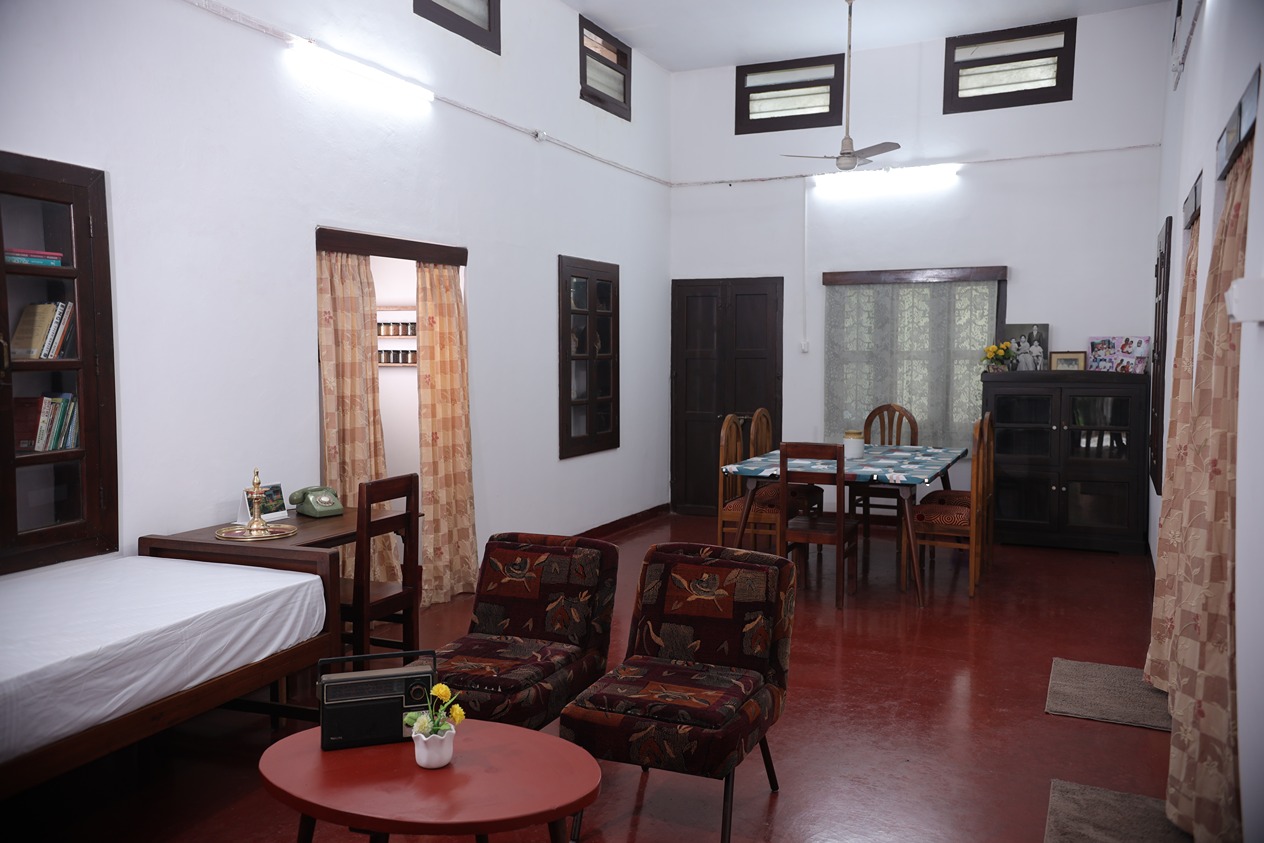
There’s also the practical dimension of comfort. A private villa like Pudumana gives families and groups a space that actually fits them: three bedrooms, a dining area large enough for everyone, home-cooked food that tastes as if someone made it for you, and a pool that belongs only to your group for the length of the stay. That combination is hard to find in Thiruvilwamala through a hotel, but it exists through the right homestay.
Pilgrims visiting for the Guruvayur Ekadasi festival book months in advance for good reason. If your trip coincides with any of Thiruvilwamala’s major temple festival dates, availability for quality stays gets thin quickly. Locking in early matters here more than in most Kerala destinations.
Who Pudumana Homestays Is Actually Built For
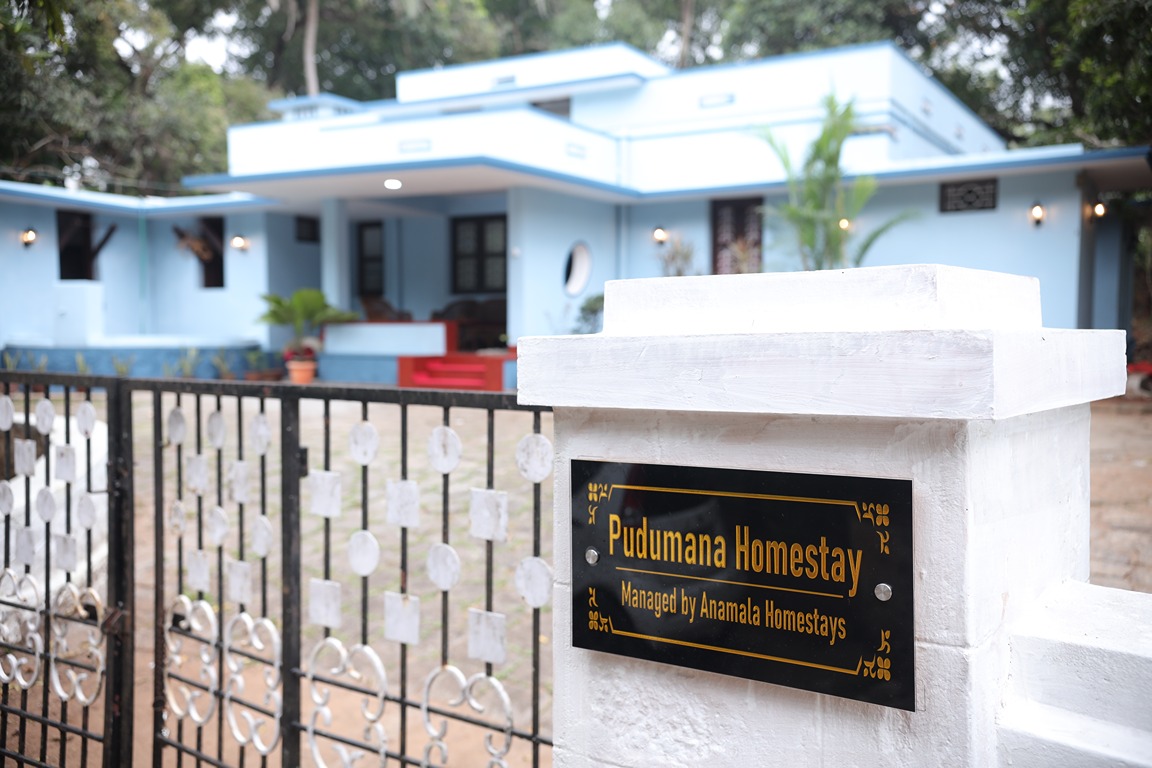
Pudumana is a three-bedroom private villa that sleeps 8 to 12 guests. You book the entire property, not a room inside it. The architecture of the stay shapes who it works for.
- Pilgrims and their families
- Families with children
- Groups of friends
- Heritage and cultural travelers
What to Look for When Choosing a Homestay Here
Thiruvilwamala’s accommodation options are not uniform in quality. A few things worth checking before committing to a booking:
• Distance to the temple: The Sree Vilwadrinatha Temple is the main reason most guests come. A stay that’s within a few kilometres makes the visit practical, especially if you’re there for early morning prayer times. Pudumana is 2 kilometres from the temple.
• Capacity and privacy: For families and groups, a private villa with exclusive use of the whole property is a different experience from a guesthouse with shared common areas. Know which you want before you search.
• Meals: Home-cooked Kerala food arranged on request is one of the main advantages of a proper homestay over a hotel. Ask specifically whether meals are available and whether the kitchen can be used independently.
• Recent reviews: Reviews from the last six months are more reliable than older ones. Look specifically for what guests say about the host’s knowledge of the area and the quality of the food, not just cleanliness scores.
• Availability timing: Around Guruvayur Ekadasi and the Parakkottu Kavu Thalapoli festival in May, homestays in Thiruvilwamala fill quickly. If your travel dates are near any temple festival, booking four to six weeks ahead is the minimum.
Best Time to Visit Thiruvilwamala
November to February: Peak Pilgrimage and Comfortable Weather
This is the most popular window for good reason. The Guruvayur Ekadasi festival and the Punarjani cave ritual fall in November or December. The weather is cooler and drier, the temple premises are at their most active, and the whole town has a particular energy during festival season. If your reason for visiting is the pilgrimage dimension of Thiruvilwamala, this is the time to come. Book your stay at least six to eight weeks ahead if your dates are near the Ekadasi.
April and May: Festival Season at Parakkottu Kavu
The Thalapoli festival at Parakkottu Kavu Devi Temple takes place on the final Sunday of Medam each May. It’s a significant local event involving decorated elephants, traditional music, and fireworks that draws visitors from across the region. The weather is hot, but the atmosphere during this festival is distinctive. Worth timing a visit around if you can manage the heat.
June to September: Monsoon and Quiet
The monsoon brings the Bharathapuzha to life and turns the surrounding paddy fields and plantation country into something that photographs as if it’s been saturated in post-processing, except it hasn’t. Fewer visitors, quieter temple premises, lower rates at homestays, and a river that actually has water in it. If you’re not visiting for a specific festival, the monsoon months offer a genuinely different and often more peaceful version of the same place.
The Place You Didn’t Know You Were Looking For
There’s a particular kind of travel that most people can’t quite articulate when they’re planning a trip but recognise immediately when they stumble into it. It’s not about ticking off a landmark. It’s about landing somewhere that has been going about its own life for centuries and is entirely willing to let you watch, if you’re patient and quiet enough to be worth watching it with.
Thiruvilwamala is that kind of place. The temple on the hill. The river below. The weavers in Kuthampully still at the same looms their predecessors sat at. The cave that opens once a year and draws thousands for a ritual that has nothing to do with tourism. Malayalam poets who fell in love with the place and stayed. A town that is exactly itself, without apology or performance.
The right homestays in Thiruvilwamala don’t just give you somewhere to sleep near all of this. They put you inside the rhythm of the place, with meals made that morning, a host who knows which side of the hill catches the light at what time, and enough privacy and space to actually stop rather than just pause between photographs.
Pudumana is three bedrooms, a private pool, home-cooked food, 2 kilometres from the temple, and about as close to the real Thiruvilwamala as a guest can get without actually living there. The Bharathapuzha is nearby. The weavers are down the road. The cave opens in November.
Thiruvilwamala is worth more than a day trip. Come for the temple, stay for the river, leave understanding why a poet chose to spend his time here. Visit pudumanahomestays.com to check dates, explore the property, and book the stay before the festival weekends you’ve got in mind are gone. WhatsApp the team on 9778151748 for a quick confirmation.